
Academic performance
Remember more.Set the Curve.
Retainory turns your course material into an optimized study system that decides what to review, when to review it, and how to excel.
The line on the left is one lecture in your memory. Keep scrolling.
Day 1 · unreviewed
Set your objectives.
Recall starts falling the moment the lecture ends. Set your objectives, add your materials, and start tracking your memory and your readiness against the date that actually matters.
Tracking, scheduling and optimizing are complicated and time-consuming. Leave the logistics and the neuroscience to us, so you can focus on the material.

Each node · one review
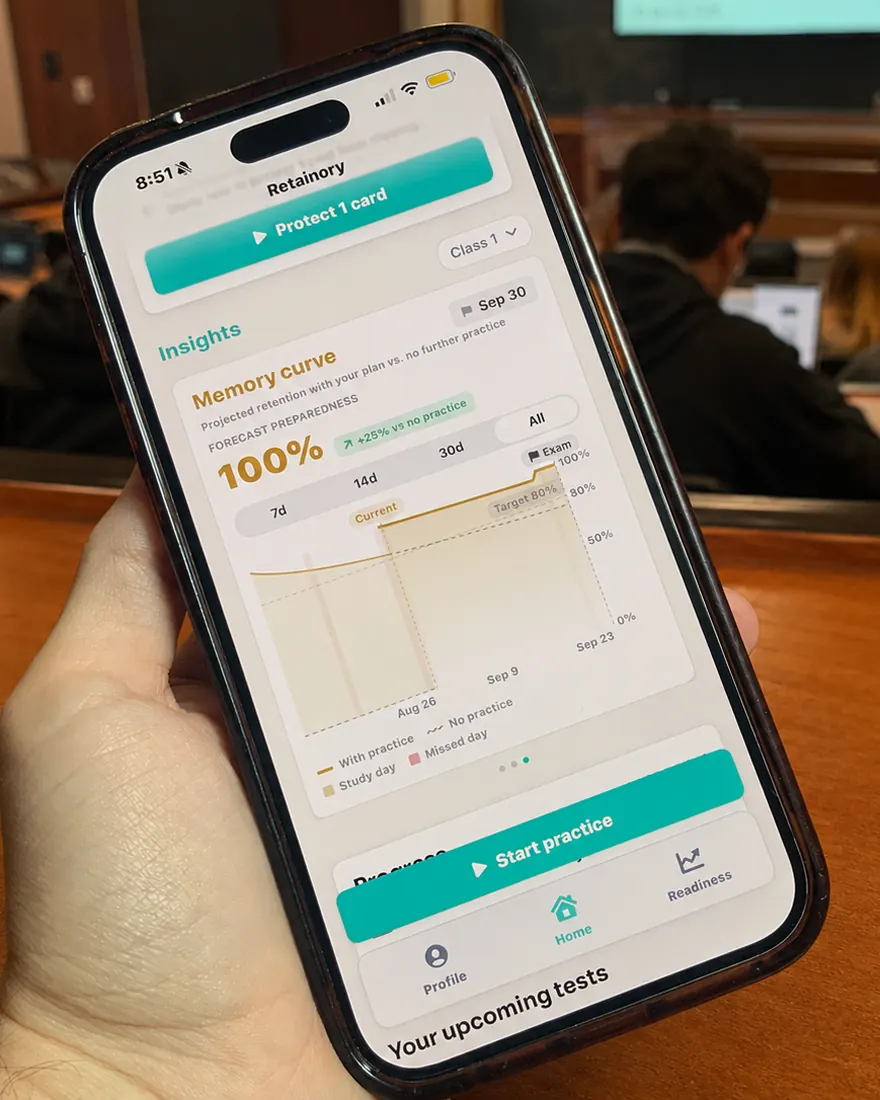
Your memory curve sets your review schedule.
Retainory schedules each session for the day your recall needs the support. The timing is drawn from the science, so you never review so early that you waste the session, or so late that you have to learn it again.
Your plan adapts to every session and every review. Because each successful review makes the memory more stable, the gap to the next one gets longer — the line stops falling, and the reviews spread out.
- Add a PDF or paste notes
- Cards drafted per concept
- You answer before you see
Ranked · every objective
Know what you don't know yet.
Every answer updates an estimate of what is still retrievable. Retainory ranks your objectives by how fast they are decaying and how close the exam is, so the material that needs you surfaces on its own.
Confidence is the least reliable signal a student has. This replaces it with one that was measured.
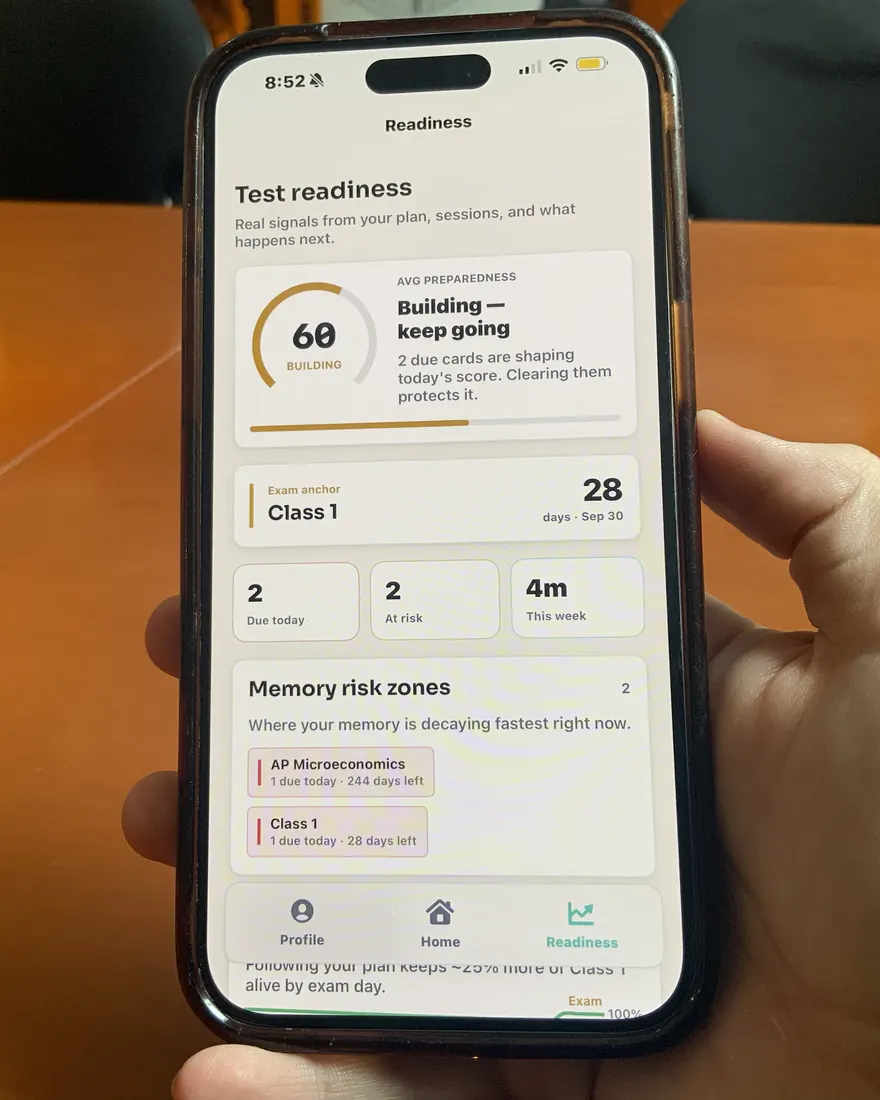
Exam date
Walk in prepared.
Walk into your exam knowing you replaced cramming with an optimized study schedule — one that had you studying less and absorbing more. Set the date on day one, and from then on one figure tells you where you actually stand against it.
Nothing here is a streak or a badge. It's an instrument, and instruments are only useful when you trust them to disagree with you.

Set the Curve
The goal isn't more studying. It's moving your position on the curve.
Everyone in the room reads the same chapter. What separates the results is how much of it survived the three weeks in between. Retention is the lever almost nobody pulls.
Start Retaining FreeThe science
Three mechanisms, implemented rather than cited.
Retainory was built with one of the leading minds in memory and retention, now an AI researcher at a top lab, to adapt the science behind FSRS-6 scheduling for test prep.
Encoding
What you keep is decided at intake.
Memory encoding is the process by which incoming information is transformed into a mental and neural representation that can be stored in long-term memory, with what is ultimately remembered depending on how the material is processed at intake (Craik & Lockhart, 1972; Tulving & Thomson, 1973; McGaugh, 2000).
Your notes are stored, summarized and compartmentalized into flashcards and other study formats, to improve how your material is learned and encoded into long-term memory.
Memory consolidation
A memory has to be stabilized after the fact.
Memory consolidation is the progressive post-acquisition process by which initially labile memory traces are stabilized and reorganized into durable long-term representations, including a gradual shift from hippocampus-dependent to distributed neocortical storage (Dudai, 2004; McGaugh, 2000; Frankland & Bontempi, 2005).
FSRS-6 estimates each card's stability and difficulty, then applies spaced repetition to improve memory consolidation.
Retrieval
Retrieval is not only a symptom of learning. It's a cause of it.
Memory retrieval is the process by which stored information is accessed and reconstructed from long-term memory into conscious awareness, with success depending on the match between current cues and the way the information was originally encoded (Tulving, 1983).
Every session asks you to retrieve what you encoded and consolidated. That act is what solidifies the learning and holds the retention in place.
Citations16 sources
Cited above, in order
Craik, F. I. M., & Lockhart, R. S. (1972). Levels of processing: A framework for memory research. Journal of Verbal Learning and Verbal Behavior, 11(6). DOI
Tulving, E., & Thomson, D. M. (1973). Encoding specificity and retrieval processes in episodic memory. Psychological Review, 80(5). PDF
McGaugh, J. L. (2000). Memory — a century of consolidation. Science, 287(5451). PDF
Dudai, Y. (2004). The neurobiology of consolidations, or, how stable is the engram? Annual Review of Psychology, 55. PDF
Frankland, P. W., & Bontempi, B. (2005). The organization of recent and remote memories. Nature Reviews Neuroscience, 6(2). DOI
Tulving, E. (1983). Elements of Episodic Memory. Oxford University Press. Précis in Behavioral and Brain Sciences, 7(2). Abstract
Further reading on methodology
Ebbinghaus, H. (1885). Über das Gedächtnis. — the original decay measurements.
Rubin, D. C., & Wenzel, A. E. (1996). One hundred years of forgetting: A quantitative description of retention. Psychological Review, 103(4). PDF
Wixted, J. T. (2004). The psychology and neuroscience of forgetting. Annual Review of Psychology, 55. PDF
Roediger, H. L., & Karpicke, J. D. (2006). Test-enhanced learning. Psychological Science, 17(3). PDF
Cepeda, N. J., Pashler, H., Vul, E., Wixted, J. T., & Rohrer, D. (2006). Distributed practice in verbal recall tasks. Psychological Bulletin, 132(3). PDF
Diekelmann, S., & Born, J. (2010). The memory function of sleep. Nature Reviews Neuroscience, 11(2). Record
Karpicke, J. D., & Blunt, J. R. (2011). Retrieval practice produces more learning than elaborative studying with concept mapping. Science, 331(6018). PDF
Dunlosky, J., Rawson, K. A., Marsh, E. J., Nathan, M. J., & Willingham, D. T. (2013). Improving students' learning with effective learning techniques. Psychological Science in the Public Interest, 14(1). PDF
Murre, J. M. J., & Dros, J. (2015). Replication and analysis of Ebbinghaus' forgetting curve. PLOS ONE, 10(7). Open access
The scheduler: open-spaced-repetition/fsrs4anki.
Pricing
Free.
The full scheduling engine, your own material, no trial timer and no account. There is no paid tier today. If one ever arrives, it will be announced here first.
Don't study to keep up
Set the Curve.
Walk into the exam knowing you're prepared, because something measured it.